Your Body Is in Crisis, Not Being Lazy
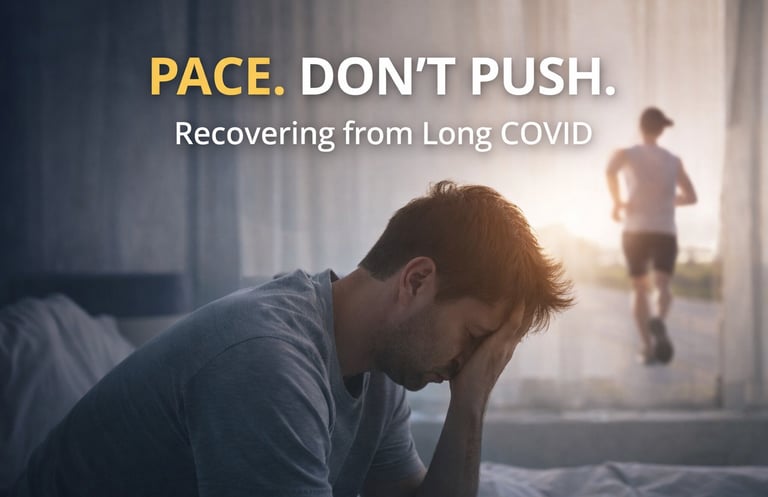
Pushing through Long COVID fatigue isn’t strength—it worsens your condition, while pacing your activity to match your body’s limits is the key to real recovery.

“I thought I was just being weak.”
This is something I hear from a lot of people I work with during Long COVID recovery.
And it couldn’t be further from the truth.
This Is Not About Willpower
If you are trying to “push through” your symptoms, it’s important to understand what’s actually happening in your body.
You are not lacking discipline.
You are not being lazy.
You are trying to function while your system is under strain. A huge strain.
A simple way to think about it:
It’s like driving a car with the broken gearbox.
You might get through the day.
You might even manage a few tasks.
Everything you do cause the engine to use a lot of fuel and get red hot. Yet not much speed is being generated.
The engine is under stress — and the longer you ignore it, the greater the damage becomes.
What I See in Practice
I’ve worked with people who had been managing — just about — by pushing through.
They kept going to work.
They kept up with responsibilities.
They kept telling themselves they just needed to try harder.
Until their system said “no.”
Some of them went from coping…
to being completely overwhelmed by fatigue.
In the most severe cases, people become so depleted that even small movements — like adjusting a blanket — feel like too much.
This is not a failure of effort.
This is the body stepping in to protect itself.
Why “Pushing Through” Backfires
When your system is in this state, every time you go beyond your capacity, you trigger a physiological response.
Inflammation increases.
The nervous system shifts further into a stress state.
Recovery slows down.
Over time, this creates a cycle that is difficult to break.
A helpful metaphor I often use with clients is this:
Think of your energy like making gravy.
You want it to gently simmer — steady, controlled, manageable.
But if you turn up the heat too much, it boils over.
And once that happens, it takes time and effort to clean up the mess.
That “boil” is what many people experience as a crash —
a spike in symptoms that can set recovery back significantly.
The Way Forward: Pacing
This is where pacing becomes essential.
Pacing is not about doing less for the sake of it.
It’s about doing the right amount — consistently — so your system can stabilise and recover.
And this is where many people go wrong:
They try to follow generic advice.
But pacing is not one-size-fits-all.
For example:
One person may tolerate 20 minutes of activity followed by 10 minutes of rest
Another may need 15 minutes of activity and 30 minutes of rest
Both are valid.
Because pacing must match your current capacity, not what you wish it was.
Finding Your Rhythm
Recovery begins when you stop fighting your body and start working with it.
That means:
respecting your limits
reducing unnecessary “spikes” in activity
and building a consistent, manageable rhythm
This is not about giving up your life.
It’s about creating the conditions where your body can begin to rebuild it.
A Final Thought
If you’ve been feeling guilty for being tired — pause for a moment.
Your body is not failing you.
It is trying to protect you.
And when you start listening to it, rather than pushing against it,
that’s when real recovery can begin.
If you want to start to pace better, read this article:
#LongCovidRecovery
#Pacing
#LongCovid
© 2026 The Integrated Long COVID Recovery ProgrammeTM All rights reserved.
Terms and Conditions